
Is Cambridge School Better Than CBSE? A Complete Comparison

If you’re a parent in India, chances are you’ve found yourself in this exact situation. Your child is approaching school-going age, or perhaps they’re already in school and you’re wondering if you’ve made the right choice. You hear other parents talking about Cambridge schools with that certaintone of prestige, while others swear by CBSE for its structured approach. And somewhere in the back of your mind, the question keeps nagging: is Cambridge school actually better than CBSE?
We get it. This is one of the most significant decisions you’ll make for your child’s future. The school they attend and the curriculum they follow shapes their thinking, their problem-solving abilities, and ultimately, their career path. It’s no wonder this question causes so much deliberation.
The honest answer? There’s no one-size-fits-all answer. What works brilliantly for one child might not suit another at all. The “better” option depends entirely on your child’s learning style, your family’s future plans, and what you value most in education.
Let’s break down everything you need to know about both systems so you can make an informed decision for your family.
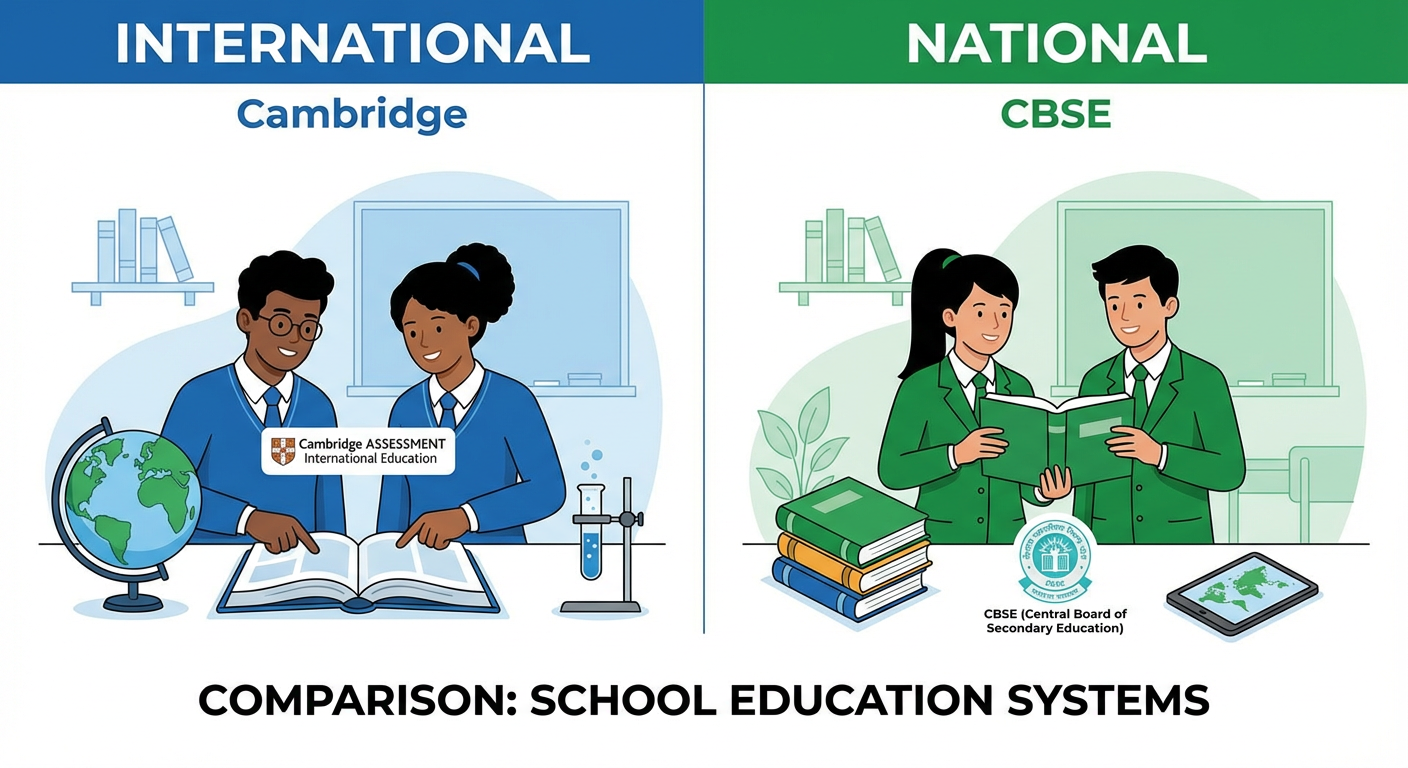
CBSE vs Cambridge: Overview
What Is CBSE?
The Central Board of Secondary Education, commonly known as CBSE, is India’s largest educational board. It operates under the Union Government of India and is followed by thousands of schools across the country and internationally.
CBSE follows a structured curriculum that’s designed to align with competitive entrance exams like JEE (for engineering) and NEET (for medical). The board conducts final examinations for Class 10 and Class 12, which are recognized throughout India and by many international institutions.
The CBSE approach emphasizes conceptual clarity and application-based learning. Students are prepared systematically for standardized tests, which can be advantageous when navigating India’s highly competitive academic landscape.
What Is Cambridge?
Cambridge International, offered through Cambridge Assessment International Education, is a UK-based curriculum with schools in over 160 countries worldwide. Cambridge schools in India follow the Cambridge Primary, Lower Secondary, Upper Secondary, and Advanced Secondary programs.
The Cambridge approach is fundamentally different. It focuses on developing critical thinking, problem-solving skills, and a deeper understanding of concepts rather than rote memorization. Students learn to analyze, evaluate, and create — skills that are increasingly valuable in today’s rapidly changing world.
Cambridge assessments are known for their rigor and global recognition. The IGCSE (International General Certificate of Secondary Education) and A-Level examinations are accepted by universities worldwide, including Ivy League institutions in the US and Russell Group universities in the UK.
Cambridge vs CBSE: A Detailed Comparison
1. Curriculum Structure and Approach
Here’s where the philosophies diverge significantly.
CBSE follows a more linear progression. Students study specific subjects at each grade level, with examinations at the end of each academic year. The curriculum is comprehensive and covers all necessary topics within each subject. There’s a strong emphasis on Science and Mathematics, which prepares students well for India’s competitive entrance examinations.
Cambridge, on the other hand, offers more flexibility. Students can choose subjects based on their interests and strengths, particularly in the upper secondary years. The curriculum encourages exploration and deeper inquiry. There’s greater emphasis on independent research, presentations, and project work.
Think of it this way: CBSE is like a well-paved highway with clear signs pointing to the destination. Cambridge is like a network of trails that lets you explore various paths before finding your way. Both can get you where you want to go, but the journeys are quite different.
2. Assessment and Examination Patterns
CBSE examinations are largely pen-and-paper tests, though the board has been introducing more practical components. The assessment is primarily summative — meaning students are tested at the end of each unit or term. There’s considerable pressure on final board examinations, as these scores determine college admissions.
Cambridge uses a combination of formative and summative assessments. Students complete coursework, practical experiments, and project work throughout the year. The final examinations are just one component of the overall grade. Cambridge also offers options like IGCSE, which includes practical assessments and oral components.
This difference matters. Some students thrive under the structured exam pressure of CBSE. Others perform better when their assessments are spread throughout the year, reducing exam anxiety.
3. Recognized vs. Recognized
Both CBSE and Cambridge qualifications are recognized — but the extent varies.
CBSE is recognized throughout India and by many international universities, particularly those in the subcontinent and Middle East. If your child plans to pursue higher education in India, CBSE provides excellent preparation for entrance examinations.
Cambridge qualifications have broader international recognition. They’re accepted by universities in the UK, US, Canada, Australia, Singapore, and many other countries. If you’re considering sending your child abroad for higher education, Cambridge provides a smoother transition.
CBSE v Cambridge: Future
1. Preparation for Higher Education
Let’s talk about what happens after school.
Students from both systems have successfully reached prestigious institutions worldwide. However, the preparation each provides is different.
CBSE students often have an edge when appearing for India’s competitive entrance exams like JEE and NEET. The structured approach and comprehensive coverage of subjects prepare them well for these tests. If your child is targeting IIT, AIIMS, or other premier Indian institutions, CBSE provides focused preparation.
Cambridge students are well-prepared for international examinations like SAT, ACT, and Cambridge-specific assessments. Their stronger foundation in critical thinking and independent research helps in the application process for foreign universities, which often look for well-rounded individuals rather than just academic scores.
2. Skill Development
This is where Cambridge often has the edge.
Cambridge curriculum explicitly focuses on developing skills that transfer to higher education and careers. Students learn to think independently, conduct research, analyze information critically, and communicate effectively. These skills are increasingly valued in today’s job market, where AI and automation are changing the nature of work.
CBSE has been evolving to incorporate more skill-based learning, but the emphasis remains on content coverage and examination preparation. Students emerge from CBSE with strong foundational knowledge, which is valuable, but might need additional development in critical thinking and research skills.
Making Your Decision
What Works Best for Different Children
Here’s the honest truth: the “better” option depends entirely on your specific situation.
Choose CBSE if:
- You plan for your child to pursue higher education in India
- Your child performs well under structured examination pressure
- You want focused preparation for competitive entrance exams
- You prefer a more traditional, content-driven approach
- Cost considerations are significant, as Cambridge schools tend to be more expensive
Choose Cambridge if:
- You’re considering international higher education
- Your child thrives with inquiry-based, project-driven learning
- You want emphasis on critical thinking and creativity
- Flexibility in subject choices is important to you
- Your family may relocate internationally
| Factor | CBSE | Cambridge |
|---|---|---|
| Best for India exams | Excellent | Good |
| International recognition | Good | Excellent |
| Curriculum style | Structured | Flexible |
| Assessment | Exam-focused | Balanced |
| Cost | More affordable | Premium pricing |
| Skill focus | Content knowledge | Critical thinking |
What Parents Commonly Experience
Talking to parents across Chennai and other cities, we hear consistent themes.
Parents who chose CBSE often appreciate the structured approach and the clarity of expectations. They feel confident knowing exactly what their child needs to learn at each stage. Many mention the strong foundation in core subjects that CBSE provides.
Parents who chose Cambridge frequently highlight their child’s improved confidence and independent thinking. They notice their children asking better questions, researching topics on their own, and presenting ideas more effectively. The global perspective and international outlook are commonly mentioned benefits.
The key insight? Both systems can work wonderfully. The success depends far more on the individual child, the school’s quality, and the support system at home than on the curriculum itself.
Also read: Building Confidence Over Competition: A New Way to Learn
The Bottom Line
So, is Cambridge school better than CBSE?
The answer is: it depends on what you’re looking for and what your child needs.
CBSE provides an excellent, structured foundation with strong preparation for India’s educational system. Cambridge offers broader international perspective with emphasis on critical thinking and global recognition.
At the end of the day, both curricula can launch your child toward a successful future. What matters most is finding a good school that implements the curriculum effectively, supports your child’s individual needs, and fosters a love of learning.
We recommend visiting both CBSE and Cambridge schools in your area. Observe the classrooms, talk to teachers, and see how your child responds. The best decision comes from understanding your specific situation, not from following what others do.